I’m so sick of your idiotic takes on method acting.
I stupidly clicked on this, knowing it would enrage me.
Here’s the thing: Katherine Heigl, while very compelling and hard to take your eyes off of on screen, is not a good actress.
She just simply isn’t. When she is “just acting” something, it is quite plain to see that she is “just acting.” Which is to say, she is not convincing as a real person, speaking honestly.
Here is a scene where she is “Just acting.”
In this scene, one of her very best friends, and her roommate, Meredith Grey, is on the brink of death.
Her bad acting in this scene makes the entire scene not make sense. Everyone is distraught. Why are they standing around listening to her listlessly say inane, random, unconnected things? Why is she saying any of this at all? Every word is completely unjustified. We could call it rambling, except there is no indication that these words are coming to her fresh. It sounds like someone reading words from a page, and words that she herself doesn’t understand, and doesn’t want to say.
That’s “Just Acting” for you.
Contrast that with her scene with Denny. In this scene–wherein the circumstances are actually much more far-fetched, and less likely to be relatable to her–but patient/boyfriend is going to die if he doesn’t get a new heart. She concocts a horrifying plan to cut his LVAD wire and force the issue so he’ll get a new heart sooner.
To tackle this scene, she did what actors who are not lazy USUALLY do: She attempted to connect with the character using her personal experience. She remembered how she felt when her brother died. And what came out of it was one of the more iconic scenes of Grey’s Anatomy.
Now, this isn’t great acting, either. But it is remarkably better acting than what she achieved in the first scene. She says she spent a day really immersing herself in some old wounds to get there. What makes the scene so moving to Grey’s fans, and so much better than the previous scene is that 1. There is real urgency. 2. There is real friction between her and her scene partner (mostly coming from her–Jeffrey Dean Morgan is a dreamboat, but he doesn’t really give much in his acting either). 3. You can remove the words and still follow the plot of the action, because it exists in the acting–in her face, in her body, in the music of her voice: A woman is under pressure. She has a far-fetched plan that has to work. When she gets pushback, she crumbles and reverts to her most basic ability to plead her case: She cries and squeals like a child, unable to think of anything else to do. It is embarrassing in the best way. It’s vulnerable. It’s human. It’s (more) real.
“But what about ME!” is a Grey’s line that you can toss out and it will pull any fan into exactly this moment. It was iconic. Because it is so human and captures her helplessness and desperation. For weekly television, it is absolutely “Good enough.” It is, by far, her best scene on Grey’s Anatomy, and she got an Emmy for it.
And Katherine Heigl would never do it again. She either doesn’t recognize the difference in her own work, or would rather be bad at her job than do the work to be good at her job.
Sorry if that’s harsh, but is absolutely the truth. But who cares? Plenty of actors get by on their looks. Plenty of people are lazy at work.
But what sent me absolutely spinning was this in the comments.
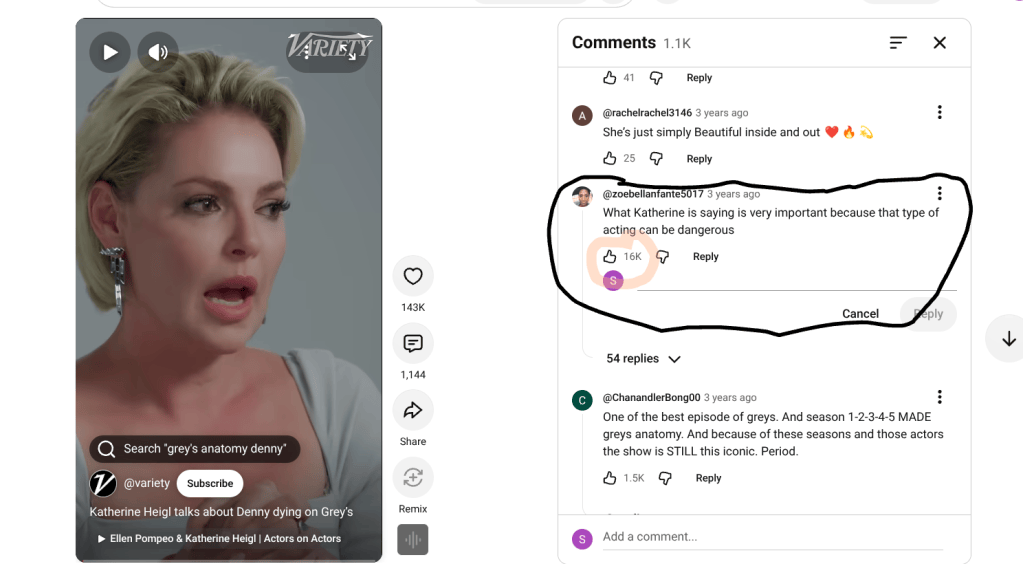
16,000 people who saw this video alone believe strongly that “that type of acting” (good acting) is DANGEROUS.
Dangerous.
To be fair, we have to remember a good many of the people online are bots. But still.
This is a narrative that is being hammered over and over and over again online: We must reject “method” acting (they use the word “method” to describe basically all methods that were derived from Stanislavski. This would include Lee Strasburg’s method, which in the past is what “The Method” referred to, as well as teachings that are off-shoots of his teachings, like Stella Adler, Uta Hagen, Sanford Meisner, and basically all 20th century methodologies for achieving character.
We are being told to believe that good art makes people bad, not that bad people sometimes make good art.
When people denigrate The Method and it’s derivatives (all of which essentially make it possible for an actor to bring forth truth from what they carry in their personal minds and bodies, such as sense memories, emotional memories; as opposed to more presentational styles, and methods wherein the internal reality is informed by the external circumstances), they are quick to point to Laurence Olivier’s quip to Dustin Hoffman in Marathon Man, when Hoffman was working overtime just to seem out of breath. “Try acting, young man, it’s much easier.” The message here is mostly, “You don’t have to be an IDIOT about it.”
Laurence Olivier represented that British style of acting where you might not throw a tantrum because your scene partner is giving you nothing to go off of, or because someone addressed you by your real name, and not your character’s name. However, you might throw a tantrum because the costume designer decided at the last minute to give you different shoes than you’re used to wearing.
Still, though, his quip is used as the end all be all argument: Method actors do too much, and go to stupid lengths that piss everyone off to achieve roughly the same result.
When you combine this idea with the fact that a lot of assholes hide behind their artistic process to justify being assholes, you come to the stunningly stupid conclusion that method acting causes people to become assholes.
But there are a lot of problems with this incoherent line of logic.
First of all: Laurence Olivier was a total asshole, in spite of not being a method actor. Secondly, Dustin Hoffman is a better actor than Laurence Olivier.
And thirdly, the final piece here: We keep seeing implications (and others downright saying it) that method acting is something only male actors use, because it is simply an excuse to be demanding, abusive, and dismissive of others–especially women, who must (we are told) cater to them and their process.
But all you have to do is look at Laurence Olivier’s treatment of method actor Marilyn Monroe to know that this isn’t true. He treated her terribly, and told her repeatedly to just simply be sexy–there was no other reality she should worry her little head about, and no need for her to portray a real human (because, he implies, she isn’t a real human). He hid behind his hatred of method acting to justify his disdain for women.
Sexists will be sexist. Regardless of their artistic process.
We attribute stupid things to method acting, because people have not been educated in the arts. At all.
I keep seeing videos that basically imply that anything extreme is method acting, and anything you don’t notice is not.
These videos are presumably made by people who couldn’t hold their own in a high school play.
Among the reasons hate method acting now?
Because some Hollywood actors will lose and gain 50 pounds in fast amounts of time to achieve a realistic look for someone in a certain role. Thin for the heroin addict. Thick for the meathead solider. For example.
But this has absolutely nothing to do with method acting. It has everything to do with wanting stars to play roles they are not suited for. And with the publicity such a physical feat brings to the movie.
Christian Bale (excellent actor) is often cited.

You’ll notice that his commitment to the role did not involve never sleeping. He ate apples and water and coffee.
Now, if this were a movie about a man who is on an extreme diet, this would be a very extreme version of method acting. But it’s not. The diet had nothing to do with the character’s struggle. He was simply doing something extreme to look a certain way on screen. Whatever else he might have done to relate to the role, which might include method acting, it’s the weight loss that is cited as an example of method acting, and method acting being self-destructive.
You may as well call Pamela Anderson a method actor because she did what was necessary to look a certain way on Baywatch.
Is there any doubt in anyone’s mind that having a creepy man become obsessed with you is something Pamela Anderson is familiar with? If you watch this scene, you may have doubts–because nothing she does has anything to do with making real the internal struggle of the character. This is not method acting. There is no correlation between going to extremes to achieve a certain body and the method. Whatsoever.
Which isn’t to say you can’t use your body to help you get into the internal world of the character. I’m sure Christian Bale probably DID spend a few sleepless nights to get into the world of an insomniac. We don’t hear that–because it’s boring and rudimentary.
And I’ve seen productions ruined by an aversion to method acting. I was once stage manager on a production of Woyzeck, a German expressionist play about a man who makes his living being experimented on by the government. He is on a strict, mandated diet of only peas. At the end, he kills his wife based on his own fantasies of betrayal. The director, who openly believed actors were no different than lighting instruments or props to be arranged around a stage, explicitly told the actors to stop worrying about the internal world of the play, and instead, simply enact the staging. He even went so far as to change the genders of the characters just days before we opened, negating almost every choice the actors had been making for weeks.
He was very Darren Nichols from Slings and Arrows.
But the lead actor really had to actually GET THERE. There was no getting around his emotional arc. If we didn’t understand why he killed his wife, the play made no sense.
And the actor couldn’t get there. Because all of his acting tools were stripped away. One day of eating nothing but peas (or even just skipping breakfast and lunch) might have made it apparent to him how a guy can get so hungry and fucked up from bad diet, that he starts to become paranoid and hostile towards people he loves. The physical circumstances were at the heart of the emotional life. But he was left to struggle with no tools to help him out, because the director had no respect for acting, and barred character development entirely. It was strictly a visual piece–much like what Darren Nichols was hoping to achieve, before he had a change of heart.
The actors on Slings and Arrows are Canadian, Shakespearean actors. They mostly wouldn’t be classified as “method” actors either. In their style of acting, the emotional life is MOST revealed in the meter and poetry of the script–which is an external construct. However, creating the inner life must be a consequence, or the actor has failed. Whether you get there working outside in, or inside out, the emotional life of a character must be revealed for the acting to be any good at all. Darren Nichols represents what happens when we get too far away from the internal life of the characters, and the actors simply become interchangeable props.
Which, I suspect, is precisely what propagandists who denigrate the method so vehemently are aiming for.
Bad acting is the goal. Why?
Because good acting reveals truth. And when you put it up against bad acting, it can also reveal what is untrue.
The destruction of the arts is necessary for propaganda to be effective.
So why do people fall for it?
Darren Nichols is a bitter, cynical character on Slings and Arrows. He is a postmodernist, in love with the German school of theatre, who believes the theatre is most effective when it reveals power constructs and breaks down the things that we generally accept as truth. He takes a play about passionate love, like Romeo and Juliet, and turns it into a play about alienation due to power constructs, essentially saying to the audience, “The human relationships are besides the point. The most important thing is to know who is pulling the strings.”
In a world where humans relationship are few and far between, where people are already alienated, already isolated, and obsessed with the power constructs that made them feel this way, it is easy to look at human emotions, connections, desires and say, “All of this is a construct. Love isn’t real. Nothing fucking matters.”
But Romeo and Juliet is a play where the power constructs are ONLY made apparent when they are confronted by what is MORE real: Human connection and love. In the face of two crazy kids from opposite sides of the tracks falling in love, the politics between the families are what cease to have meaning. The construct is revealed. And we move from saying, “Nothing matters” to knowing that something matters: Our humanity.
It’s resonated for hundreds of years, because it is relatable. It is true. And it’s revealed by acting that animates the inner life of the characters. The falsehoods of life are made plain by the truth of performance.
Propagandists love them some postmodernism and nihilism.
“All art is political!” is the rallying cry of many activists, and is an easy thing agree with. After all, all humans have a perspective, and politics are part of that. And in a world where so much art IS produced with an agenda–is, in fact, not art, but advertising and propaganda, it is easy to extrapolate that out to all art being political.
But what is “dangerous” is believing that there is no such thing as truth, and that all artists are propagandists. Which is what “All art is political” inevitably leads to. What is political? To manipulate towards an agenda? All art is political means Art=propaganda. The messaging is: My propaganda is as good as the truth you present. (my propaganda=your truth=there is no truth=people in power decide the truth).
This is not a road we want to go down.
What happens if we do this to the scientific method?
If we took this attitude towards science, and decided that all science is political, and the culprit of abuse in science is the use of the scientific method, any charlatan in the world could create any kind of poison, any kind of wrong result, any kind of political messaging and claim it as science–as truth–and furthermore, shrug when someone comes up with a contradictory result that seems MORE true. “Well, that’s YOUR truth. This is an “alternative truth to YOUR political agenda.”
We understand that science is meant to reveal truth, though. And so we are a bit more precious about the methodology.
On the other hand, though: Most people don’t understand acting, yet it feels very familiar because it portrays our very lives, in better ways than we could portray them ourselves, when the actor is good at his job. Because the actor makes himself clear, we believe we understand acting. “It’s just pretend, right? I used to do that as a kid. (and therefore, that’s stupid kid stuff.)”
But as adults, we are very, very, very, very, very, very jealous of actors. Because while not everyone wishes that they could find out what the life cycle of a fruit fly is REALLY like, as a scientist might, every person on the planet wishes they could express themselves eloquently, in a way that will break your heart. We wish people would listen to us with rapt attention.
And that usually doesn’t happen.
It seems like magic. It seems like magic born of inexplicable confidence. “And why the fuck are YOU so confident, actor? All you do is say someone else’s words and workout! You’re a fucking salesman!”
At the end of the day, though…I mean…is there really a difference if you get the lines out? Aren’t I just taking this acting thing too seriously? We’re talking about an actor on Grey’s Anatomy.
(Which in its golden days had some truly incredible actors on it. Heigl wasn’t one. Just saying).
Actors are not interchangeable, talent is not interchangeable, and methodology is not interchangeable. Because human beings are not props. They ARE the play.
In the last scene of Slings and Arrows, Jeffrey (who is the protagonist and Darren’s foil) is directing King Lear, and directing it with a man in the lead who is actively dying–is actively losing everything–his dignity, his standing as a great actor, his mental faculties. He has everything in common with Lear and his personal life is the basis for his performance. And using him in the production is, in many ways, a tremendous mistake: The production is constantly brought to a halt by his inability to focus and emotional outbursts.
The Method, amiright?
But at last, he gets to perform it. And it’s among the most heartbreaking Shakespearean performances ever put on a stage. This isn’t just something they say as characters, to tell the audience that this is a great performance. It is truly a great performance, by a great actor.
The following is the entire last episode. I recommend the entire series (it’s currently all on YouTube). But this gets at the entire heart of the argument. In this episode, we see the nihilistic Darren Nichols become the corporate pawn that he was always going to be. This is the fate of people who believe all art is political. People who believe nothing matters, and nothing is strictly true cannot sell out–because they have no principles. Corporate pawn is their destiny, not a betrayal of self. It’s who they are, and how they justify themselves.
We see various approaches to the theatre debated and denigrated, but meanwhile, it’s all for naught–the theatre is now under Darren Nichols’ control, and exists for box office sales, not art. We see the impossibility of the show going on. We see that despite the futility, the poverty, the powers that confront you, how easy, at last, to just quite simply show up and do it anyway–how an actor who does anything to put the show on, and is not tied to pomp and circumstance, and is devoted to being excellent, can, out of his own dynamic self, reveal the truth.
I don’t believe you need much context that isn’t already addressed in the last episode, except to know that Oliver is a ghost. If you need more, watch the whole series)
Most importantly, we see why, in spite of the impossibility, the frustration, the overwhelming odds, and the innumerable people on the planet who want to stop you in your tracks: The show MUST go ON.


Leave a comment